
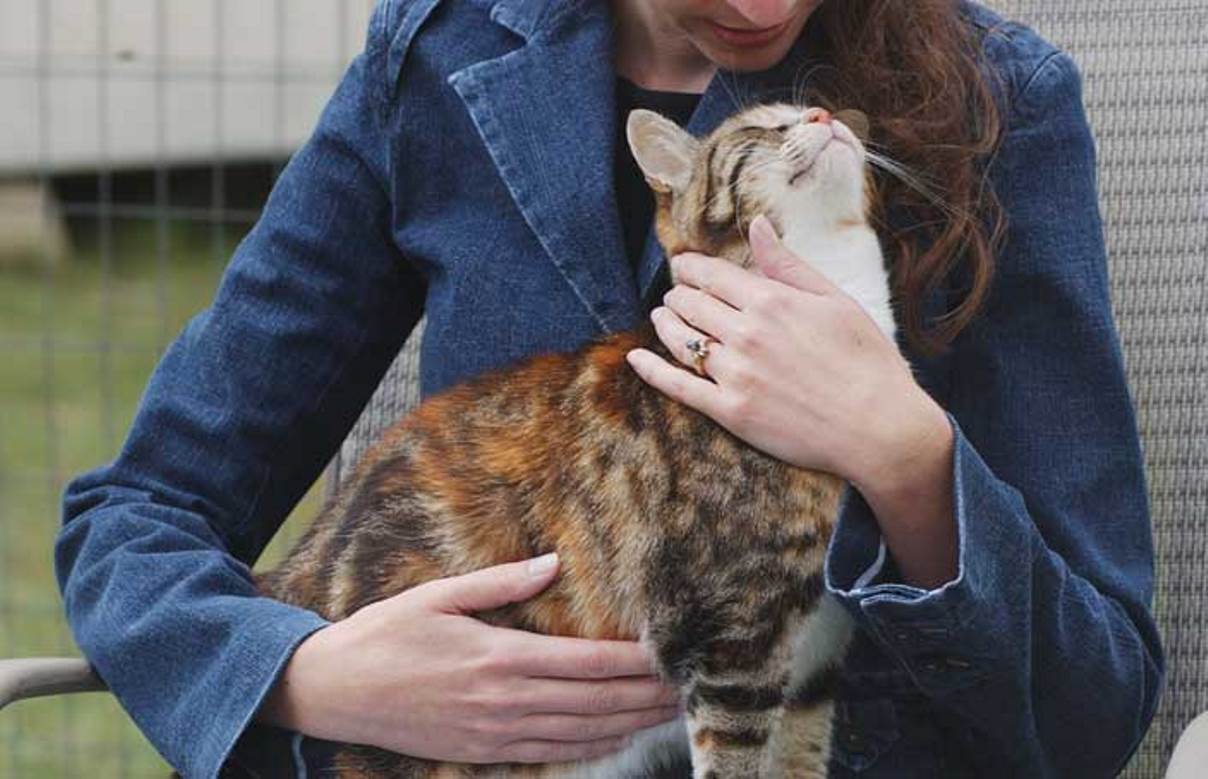
Reiki is a Japanese spiritual and wellness practice in which a practitioner places their hands lightly on, or just above, a person or animal. Some cat guardians use it as a quiet ritual of attention and companionship. There is not good evidence that Reiki treats feline disease, corrects a measurable energy blockage, relieves pain, speeds surgical recovery, improves immunity, or changes the course of cancer.
The safest way to think about Reiki for cats is as optional, low-stimulation time that must never replace veterinary diagnosis, medication, pain control, emergency care, or hospice planning. A cat cannot agree in words, so participation has to be voluntary and judged from behavior. If the cat moves away, hides, freezes, flattens the ears, lashes the tail, growls, hisses, swats, or bites, stop.
What Reiki can—and cannot—offer a cat
| Possible role | What it does not establish | Safer interpretation |
|---|---|---|
| A calm person sits nearby | That energy is being transferred | Quiet company may be pleasant if the cat chooses proximity |
| A cat rests or sleeps | That pain or disease has improved | Resting can reflect comfort, fatigue, illness, or ordinary sleep |
| A guardian feels calmer | That the cat’s condition has changed | A calmer guardian may observe and handle the cat more gently |
| A meaningful spiritual ritual | That eight feline chakras exist as anatomical structures | Energy and chakra language can be held as belief or metaphor |
The American Veterinary Medical Association’s guidance on complementary and alternative veterinary medicine says these approaches should be held to the same standards as other veterinary care and that safety and effectiveness claims should be demonstrated scientifically. “Natural,” “non-invasive,” and “hands-off” do not automatically mean effective or risk-free.
Veterinary care comes first
Allergies, epilepsy, respiratory disease, arthritis, injury, anxiety-like behavior, cancer, and postoperative recovery require veterinary assessment. Reiki should not be presented as a treatment for any of them. Do not delay an examination because a practitioner says a chakra is blocked, a healing response is underway, or the cat is releasing toxins.
Cats often conceal illness and pain. The Feline Veterinary Medical Association’s pain guide lists behavior changes such as hiding, reduced appetite, less grooming, reluctance to jump, altered toileting, squinting, a hunched posture, sensitivity to touch, and changed temperament. New or worsening changes deserve a call to the veterinarian even if the cat appears peaceful during a quiet session.
Never change treatment on a Reiki practitioner’s advice
Only the prescribing veterinarian should decide whether to change pain medicine, seizure medicine, cancer treatment, supplements, diet, or postoperative restrictions. Do not apply oils, herbs, crystals, heat, magnets, or pressure unless the veterinarian has approved the specific product and method. Cats groom their coats and can ingest substances placed on the skin.
A cat-led, ten-minute quiet-companionship practice
This routine does not claim to heal. Its purpose is to create a calm, optional interaction while preserving the cat’s control.
1. Ask the veterinarian about limits
Before trying any complementary practice with an ill, injured, postoperative, pregnant, elderly, or medically fragile cat, ask what handling and positioning are safe. Confirm when symptoms require a same-day call or emergency visit.
2. Prepare an ordinary safe space
Choose a familiar room with the cat’s normal escape routes, water, resting place, and litter access. Remove candles, incense, smoke, diffusers, loose cords, and unfamiliar music. For a smoke-free room ritual and practical cleaning distinctions, see spiritual cleansing.
3. Let the cat choose distance
Sit on the floor or a stable chair without blocking the doorway. Do not carry the cat into position, shut it in, corner it, restrain it, or wake it. Begin several feet away. A practitioner does not need to hover over the animal.
4. Use relaxed, neutral attention
Breathe normally and keep movements slow. You may hold a personal intention such as “I will be calm and attentive,” but do not assume you can sense a diagnosis or direct energy to an organ. Keep your hands in your lap unless the cat initiates contact.
5. Read behavior, not spiritual meaning
A soft body, ordinary grooming, exploring, or choosing to lie nearby may indicate tolerance. Freezing is not consent. Watch for turning away, skin twitching, crouching, dilated pupils, ears rotating back, tail lashing, growling, hissing, or attempts to leave. End immediately at the first sign of discomfort.
6. If touch is invited, keep it familiar
Let the cat approach and sniff. Use the same brief petting the cat normally enjoys, often around the cheeks or head. Do not press on painful areas, wounds, tumors, the abdomen, joints, or surgical sites. Do not place hands over the face or restrict movement.
7. End on time
Stop after ten minutes or sooner if the cat leaves. A cat walking away is a complete answer; do not follow or repeatedly invite it back. Restore the room and allow uninterrupted rest.
How to judge whether the routine is useful
Do not use a single nap, purr, stretch, or energetic burst as proof of healing. Purring can occur in comfortable cats, but also during pain, fear, or illness. Instead, keep a short record based on observable outcomes:
- Date, duration, and whether the cat approached voluntarily.
- Behavior before, during, and after the session.
- Eating, drinking, grooming, mobility, toileting, breathing, and medication as directed.
- Any stress signals or attempts to leave.
- Questions or changes reported to the veterinarian.
Compare the cat with its own normal behavior. A record can help a veterinarian assess a trend, but it cannot show that Reiki caused an improvement. Illnesses fluctuate, treatment takes effect, and cats naturally alternate between activity and rest.
Pain, breathing trouble, seizures, and other emergencies
Do not begin or continue a session when a cat needs urgent care. Seek veterinary help promptly for trouble breathing, open-mouth breathing, collapse, loss of consciousness, repeated vomiting, inability to urinate, severe bleeding, suspected poisoning, major trauma, uncontrolled pain, or a seizure—especially a first seizure, a prolonged seizure, or repeated seizures without normal recovery.
The ASPCA emergency-care guide also identifies signs such as pale gums, difficulty standing, paralysis, seizures, excessive bleeding, and abnormal pulse or temperature. Call the veterinary clinic or emergency hospital while preparing safe transport. Protect yourself from bites and scratches; a frightened or painful cat may react defensively.
Cancer treatment and end-of-life care
Reiki does not treat cancer, reverse treatment side effects, or strengthen a cat’s immune system. A veterinary oncology or primary-care team can address nausea, pain, appetite, hydration, mobility, breathing, toileting, and quality of life. Ask for a written plan explaining normal changes, concerning signs, after-hours contacts, and when euthanasia should be considered.
Quiet companionship may still matter. If the cat chooses to sit nearby while the guardian prays, reflects, or practices Reiki, that time can be meaningful without making a medical claim. At the end of life, prioritize comfort, familiar routines, easy access to resources, and the veterinarian’s palliative plan. For human support during anticipatory grief and bereavement, read what to do when you are grieving.
Choosing a practitioner
A responsible practitioner clearly states that Reiki is not veterinary medicine and does not guarantee healing. They ask for veterinary clearance, work in a familiar low-stress setting, let the cat control distance, stop at stress signals, and never advise changing treatment. They should also explain fees and session length before the visit.
Leave if someone claims to diagnose through energy, guarantees recovery, says worsening symptoms prove detoxification, pressures you into a package, blames you for insufficient belief, sells remedies for serious disease, or discourages veterinary care. A veterinary credential and a Reiki credential are not interchangeable; verify which role the person is actually licensed to perform.
Frequently asked questions
Can Reiki cure illness or relieve pain in cats?
There is not good evidence that Reiki cures feline disease or provides reliable pain relief. Use veterinarian-prescribed treatment and pain control. Quiet, voluntary companionship can be offered only as an optional comfort ritual.
Is hands-off Reiki completely safe for every cat?
No practice is automatically safe in every circumstance. The main risks are delayed veterinary care, stress, restraint, misreading behavior, unsafe added products, and false treatment claims. Let the cat leave and stop at any distress signal.
How can I tell whether my cat wants a session?
Begin at a distance in a familiar room and let the cat approach. Tolerance is suggested by ordinary relaxed behavior and freedom to move. Turning away, freezing, hiding, crouching, flattened ears, tail lashing, growling, hissing, swatting, or leaving means stop.
Can Reiki support a cat with cancer or at the end of life?
It cannot treat cancer or replace palliative care. If the veterinarian approves and the cat voluntarily stays nearby, a quiet ritual may comfort the guardian and provide calm companionship. Medical symptoms and quality of life still require veterinary management.