
Updated
Therapy can help people with depression understand patterns, build coping skills and work toward changes in daily life. It is a collaborative treatment with a qualified mental-health professional, not a demand to become more positive. The approach should reflect your symptoms, preferences, circumstances and clinical needs.
Depression has more than one possible contributor
The National Institute of Mental Health (NIMH) depression guide describes biological, genetic, psychological and environmental factors. Depression can affect interest, energy, sleep, appetite, concentration and everyday functioning. It is not adequately explained by a bad attitude or a single negative thought.
A health-care assessment can also consider medical conditions or medicines that produce similar symptoms. You do not need to identify the cause yourself before seeking help. Although diagnostic criteria often involve symptoms lasting at least two weeks, that is not a reason to wait if you are struggling or unsafe.
What CBT and interpersonal therapy focus on
NIMH identifies cognitive behavioral therapy and interpersonal therapy among evidence-based approaches for depression. They overlap in their concern for daily life, but they organize the work differently. Neither approach guarantees a particular result or requires blaming yourself for being ill.
| Approach | Typical focus | A useful question |
|---|---|---|
| Cognitive behavioral therapy (CBT) | Examining unhelpful thought and behavior patterns and practicing more workable responses. | How will we choose an achievable skill or activity to practice? |
| Interpersonal therapy (IPT) | The relationship between mood, relationships and life events, including communication and social support. | Which relationship difficulty or transition will we focus on? |
A therapist may use another evidence-based approach or combine methods within their training. Ask why the proposed approach fits your situation, what alternatives exist and how you will decide whether it is helping. A treatment name alone does not tell you how an individual practitioner works. For ordinary relationship uncertainty outside treatment, the relationship clarity guide offers observable questions; abuse, severe distress, and safety concerns need appropriate professional support.
The first conversation is an assessment, not a performance
You may be asked about symptoms, how long they have been present, their effect on daily activities, previous care, current medicines and concerns about safety. It is fine to bring a short note or say that explaining things is difficult. You do not need a complete life story prepared.
Describe a concrete change: “I cannot concentrate long enough to finish ordinary work,” or “I stopped enjoying things that used to matter.” Include relevant periods of unusually elevated or irritable mood, major sleep changes and substance use so the clinician has a fuller picture. These details inform assessment; they do not establish a diagnosis by themselves.
Ask what the therapist can provide and when another professional may be needed. Not every therapist prescribes medication. Therapy, medication or both may be appropriate, and decisions about prescribed treatment belong with the responsible clinician.
Use a progress conversation instead of a promise
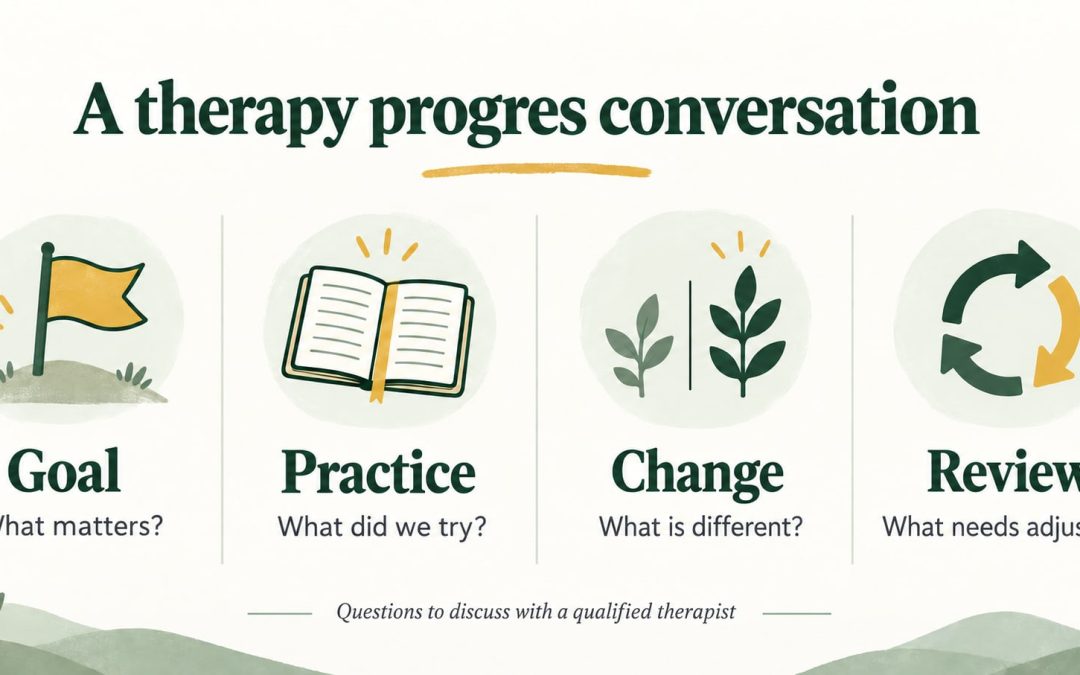
The featured guide offers four prompts you can bring to a review appointment. They are reproduced below in text. Choose one or two if a longer discussion feels difficult.
Goal: what matters?
Name a change that would be meaningful, such as managing a work task, reconnecting with someone or getting through mornings with more support. The values-to-action audit can help turn a broad value into a small, observable step; it is a reflection aid, not depression treatment.
Practice: what did we try?
Discuss what happened between sessions, what was manageable and what was inaccessible or too demanding.
Change: what is different?
Consider symptoms and functioning over time. One difficult day does not settle the question, and persistent worsening should be raised promptly.
Review: what needs adjusting?
Ask about the pace, approach, practical barriers, other treatment options and the next review point.
The NIMH psychotherapy guide recommends discussing treatment goals, progress and what to do if improvement is not happening. You can ask for an explanation, another opinion or a different provider. You should not have to conceal concerns to appear like a good patient.
Discuss access and fit before committing
Ask about qualifications and relevant experience, appointment costs, insurance or reduced-fee options, cancellation policies and whether remote appointments are available. Discuss how records are kept, the limits of confidentiality and how to contact the service between sessions.
For remote therapy, check that you have a suitable private place and understand the provider’s arrangements for urgent concerns. Availability, credentials and rules vary by location, so verify them with the service and the relevant professional register rather than assuming a title means the same thing everywhere.
Keep spiritual interests separate from treatment claims
A prayer, ritual or reflective reading may have personal meaning. It does not provide the same assessment or treatment as psychotherapy. A reader should not diagnose depression, select medication, claim to remove its cause or discourage qualified care.
You can bring spiritual preferences into a conversation with a therapist while still asking for evidence-based care. The practical aim is a plan you understand, can discuss honestly and can review as your needs change.
Frequently Asked Questions
Can therapy help with depression?
Yes. Evidence-based psychotherapies can help many people manage symptoms and functioning, but no approach guarantees a particular result. Treatment should be matched to the person and reviewed over time.
What happens in a first therapy appointment?
The clinician may ask about symptoms, duration, daily functioning, previous care, medicines, substance use, mood changes, goals, and immediate safety. You can bring notes and ask how the assessment will guide treatment.
How do I know whether therapy is helping?
Agree on meaningful goals and review symptoms, functioning, practice between sessions, barriers, and adverse or worsening experiences. Ask what will change if progress is limited.
Can spiritual practices replace depression treatment?
No. Prayer, ritual, and reflection may hold personal meaning, but they do not replace qualified assessment or evidence-based treatment. A spiritual reader should not diagnose depression or direct medication decisions.
Featured image: AI-generated editorial illustration.