
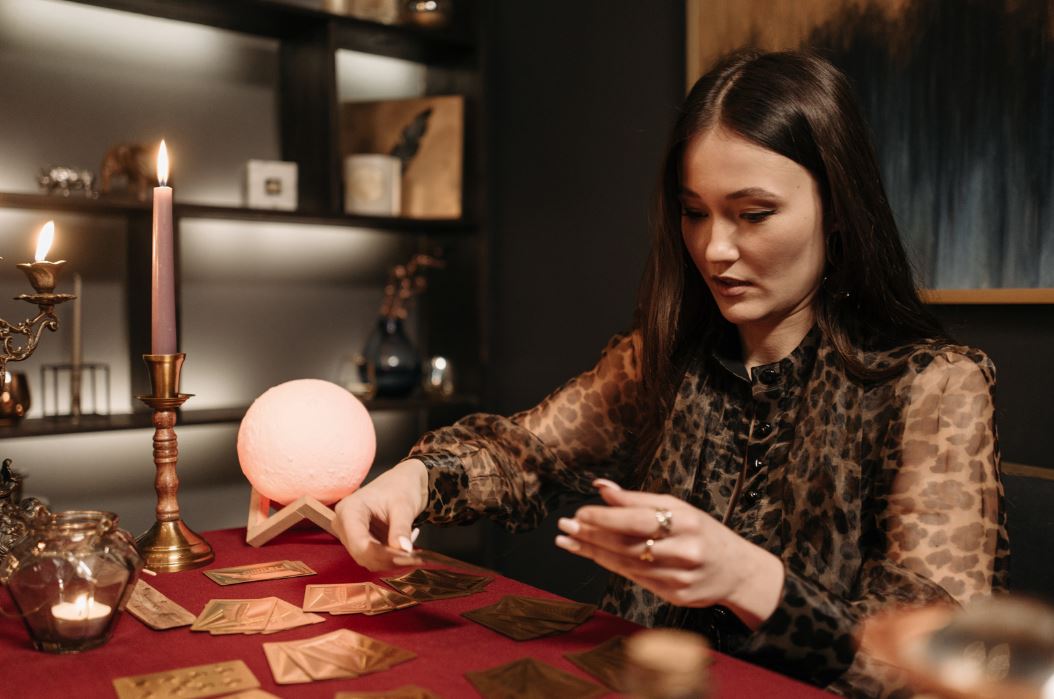
Tarot, oracle, angel, and Lenormand cards can all support reflection, storytelling, or a spiritual practice, but they are not interchangeable. Tarot follows a recognizable 78-card structure. Lenormand uses a compact 36-card symbolic system. “Oracle” is a broad category with no required size or sequence, while angel cards are usually oracle decks built around angelic or inspirational themes.
None of these cards has been shown to reveal objective facts about the future, another person’s private thoughts, a diagnosis, or a guaranteed spiritual message. Their practical value comes from the questions, associations, and conversations they prompt. You can hold a spiritual interpretation while keeping important decisions anchored in evidence and personal consent.
Quick comparison
| Deck | Typical structure | Reading style | Good starting use |
|---|---|---|---|
| Tarot | 78 cards: 22 Major Arcana and 56 Minor Arcana | Layered images, positions, suits, and established traditions | Exploring a situation from several angles |
| Oracle | Set by the creator; count and format vary | Theme-specific and relatively free-form | A daily prompt or focused reflection |
| Angel cards | Usually an oracle format; count varies | Angelic, devotional, affirming, or inspirational language | Reflection within a compatible belief system |
| Lenormand | Usually 36 named symbols | Short combinations read in relation to one another | Learning concise symbolic pairings |
Tarot: a structured visual language
A standard modern tarot deck has 78 cards. The Major Arcana contains 22 named cards, beginning with the Fool and commonly including figures such as the Magician, High Priestess, Lovers, Hermit, Death, Star, Moon, Sun, and World. The 56-card Minor Arcana is divided into four suits, usually Cups, Swords, Wands, and Pentacles or Coins. Each suit contains numbered cards and four court cards.
Those familiar structures developed over time. The Metropolitan Museum of Art’s history of early tarot cards places the earliest references in northern Italy in the 1440s and 1450s and explains that tarot began as a trick-taking card game. The strong association with occult divination became popular much later. That is more accurate than saying tarot was used for psychic readings in the 1300s.
Card meanings are not universal facts. Cups are often associated with emotion and relationships; Swords with thought, conflict, or communication; Wands with energy or initiative; and Pentacles with resources or material life. A reader may use those conventions, the card art, the spread position, and the client’s question to build an interpretation.
The Rider–Waite–Smith contribution
Many contemporary decks borrow from the Rider–Waite–Smith system. The name recognizes artist Pamela Colman Smith as well as writer Arthur Edward Waite and publisher Rider. The Victoria and Albert Museum’s history of tarot notes that the deck was first published in 1909 and that Smith’s fully illustrated numbered suit cards had a lasting influence. A deck based on this system can be easier for beginners because many books and courses discuss its imagery.
Oracle cards: the creator sets the system
“Oracle deck” describes an open category rather than one traditional deck. A set may have 30, 44, 60, or another number of cards. It might focus on animals, plants, ancestors, art, emotions, mythology, affirmations, or journal prompts. Some decks print a complete message on each card; others rely on a guidebook or the user’s associations.
This flexibility is the main advantage and the main limitation. You can choose a theme that fits your interests, but one oracle deck’s “Moon” may have little in common with another’s. Before buying, inspect sample cards, the guidebook style, the creator’s cultural sources, the physical size, and whether the tone leaves room for uncertainty.
Angel cards: an oracle theme, not a separate structure
Angel cards usually use the oracle format and frame prompts through angels, archangels, guides, prayer, encouragement, or divine care. Some people experience that language as comforting. Others may prefer a nature, art, or secular reflection deck. A person’s religion—or lack of religion—does not determine whether they can enjoy symbolic cards, but a reader should ask before introducing beliefs the client does not share.
Angel imagery does not make a deck inherently healing, safer, or more accurate. Be cautious of messages that claim a card can diagnose illness, promise protection, direct medication changes, identify a curse, or guarantee an outcome. Encouragement is different from evidence.
Lenormand: 36 symbols read in combinations
Lenormand is often mistakenly treated as the original oracle deck. It is better understood as a particular 36-card fortune-telling tradition associated by name with Marie-Anne-Adélaïde Lenormand. Common symbols include Rider, Clover, Ship, House, Tree, Clouds, Snake, Coffin, Bouquet, Scythe, Birds, Child, Fox, Bear, Stars, Dog, Tower, Garden, Mountain, Crossroads, Mice, Heart, Ring, Book, Letter, Sun, Moon, Key, Fish, Anchor, and Cross.
The exact wording and imagery can differ by edition. Cards are commonly read in pairs, lines, or a full Grand Tableau, with neighboring cards modifying one another. The British Museum holds a fortune-telling pack associated with Lenormand, illustrating how historical objects, publishers, and later traditions are connected without proving supernatural accuracy.
How to choose your first deck
- Name the job. Do you want an art object, a spiritual ritual, a journaling prompt, a social reading practice, or a structured symbolism course?
- Preview at least ten cards. Look for images you can describe without depending entirely on memorized keywords.
- Check the guidebook. Useful books explain alternatives and questions. Avoid fear-based claims or instructions to replace professional care.
- Consider access. Check card size, contrast, font, finish, hand mobility, language, and digital alternatives.
- Set a budget. One deck and a notebook are enough. You do not need crystals, cloths, certificates, or repeated paid readings to make the cards “work.”
Choose a tarot deck if you enjoy a shared structure and long learning path. Choose an oracle or angel deck if you want shorter, theme-led prompts. Choose Lenormand if you like learning concise combinations. There is no objectively “most powerful” deck.
A seven-step reading that preserves uncertainty
- Write an open question you have some power to act on: “What should I consider before this conversation?”
- Record what you already know before drawing. This prevents the card from being credited with information you supplied.
- Choose one card or a simple three-card spread. More cards do not guarantee more accuracy.
- Describe the image before interpreting it: people, objects, action, color, direction, and mood.
- Generate at least two plausible meanings, including one that challenges your first impression.
- Translate the reading into a low-risk action, such as gathering information, asking a question, or waiting overnight.
- Later, record what happened—including misses and ambiguous results. Do not rewrite a vague prediction after the event.
If you want a fuller method for comparing a hunch with outcomes, use the prospective intuition log. It helps separate what you knew beforehand from hindsight.
Questions cards should not decide
Do not use a draw as the deciding evidence for a medical diagnosis, medication change, legal deadline, investment, gambling choice, pregnancy decision, missing-person search, or whether another person consents. Cards also cannot verify fidelity, paternity, criminal conduct, a spirit attachment, or someone else’s thoughts.
For relationships, translate a card into a direct question or observable check. A Lovers card does not establish a soulmate bond, and a Devil or Seven of Swords card does not prove deception. The psychic-connection reality-check guide offers seven relationship-quality questions that depend on consent and behavior rather than a spiritual label.
If a reading produces intense fear or pressure to keep paying, pause. A responsible reader allows questions, states prices, avoids guarantees, and supports your right to stop. Persistent distress, unusual experiences that disrupt daily life, or thoughts of harm call for qualified health support or emergency help—not another card pull.
Frequently Asked Questions
What is the main difference between tarot and oracle cards?
Tarot usually follows a 78-card structure with Major and Minor Arcana. Oracle decks have no required size, suits, or sequence; the creator sets the theme and system.
Are angel cards a type of oracle card?
Usually, yes. “Angel” describes the spiritual theme, while the deck’s size and organization remain flexible. They are not proven to deliver messages from angels or to be more accurate than other decks.
Is Lenormand the original oracle deck?
No. Lenormand is a particular 36-card symbolic tradition associated by name with Mlle Lenormand. Modern oracle decks form a much broader, free-form category.
Can cards accurately predict the future?
No reliable evidence shows that cards can predict specific future events. They can be used for reflection or spiritual meaning, provided important decisions are checked against facts, consent, professional advice, and real-world consequences.